Name of 11 Pharaohs - Famous Rulers of Ancient Egypt
The warm desert breeze sweeps across the Giza Plateau as the Great Pyramid rises against the horizon.
Nearby, colossal statues gaze silently toward the Nile, preserving the memories of rulers who shaped one of humanity's most remarkable civilizations.
For travelers exploring Egypt today, few questions spark more curiosity than the Name of 11 Pharaohs who left their mark on history.
Understanding the Name of 11 Pharaohs is about much more than memorizing rulers.
It is a journey through thousands of years of political power, architectural innovation, military conquest, and religious transformation.
From the builders of pyramids to the kings who expanded Egypt's borders, each pharaoh played a unique role in shaping the ancient world.
In this guide, you'll discover the Name of 11 Pharaohs, learn where they ruled, explore their greatest achievements, and understand why their legacies continue to fascinate travelers today.
Whether you're planning one of our Egypt Tour Packages or simply deepening your knowledge of ancient history, this article will help bring Egypt's royal past vividly to life.
Table of Contents
Who Were the Pharaohs of Ancient Egypt?
The Meaning of Pharaoh
Names and Titles of the Pharaoh in Ancient Egypt
Name of 11 Pharaohs in Order
Narmer
Djoser
Sneferu
Khufu
Hatshepsut
Thutmose III
Akhenaten
Tutankhamun
Seti I
Ramesses II
Cleopatra VII
The Most Influential Pharaohs and Their Achievements
Pyramid Builders
Military Leaders
Religious Reformers
Understanding the List of Pharaohs Timeline
Old Kingdom
Middle Kingdom
New Kingdom
Late Period
Famous Pharaoh Names Travelers Should Know
Most Common Pharaoh Name
Pharaoh Names Male
Unique Royal Names
Why Pharaohs Remain Important Today
Their Impact on Egyptian Culture
What Modern Travelers Can Learn
Where to See the Legacy of Egypt's Pharaohs
Giza Pyramids
Valley of the Kings
Abu Simbel
Egyptian Museum
Who Were the Pharaohs of Ancient Egypt?
Long before modern nations existed, Egypt was ruled by a succession of kings whose authority extended far beyond politics.
These rulers were known as pharaohs, and they were considered the living link between the gods and the people.
Their decisions shaped one of the longest-lasting civilizations in human history.
For visitors standing inside the temples of Luxor or gazing at the colossal statues of Abu Simbel, it quickly becomes clear that pharaohs were not ordinary monarchs.
They commanded armies, oversaw monumental building projects, directed religious ceremonies, and maintained what Egyptians called Ma’at—the divine balance of order and harmony.
The Meaning of Pharaoh
The term "pharaoh" originally referred to the royal palace rather than the ruler himself.
Over time, it evolved into the title used for Egypt's kings.
Ancient Egyptians viewed their ruler as both a political leader and a sacred figure.
The pharaoh was believed to be chosen by the gods and responsible for maintaining stability throughout the kingdom.
This unique role explains why Egyptian monuments portray rulers on such a grand scale.
Massive statues, towering temples, and elaborate tombs reinforced the idea that pharaohs possessed divine authority.
Names and Titles of the Pharaoh in Ancient Egypt
One fascinating aspect of Egyptian royal history is that pharaohs often possessed multiple names and titles.
A complete royal titulary typically included:
Horus Name
Nebty Name
Golden Horus Name
Throne Name
Birth Name
These names highlighted different aspects of kingship, including divine protection, legitimacy, military strength, and connection to the gods.
Many travelers researching the Names and titles of the pharaoh in ancient Egypt discover that rulers were often known by several different names throughout their reigns, making Egyptian history even more intriguing.
Name of 11 Pharaohs in Order
Creating a complete list of every Egyptian ruler would require hundreds of names spanning more than three thousand years.
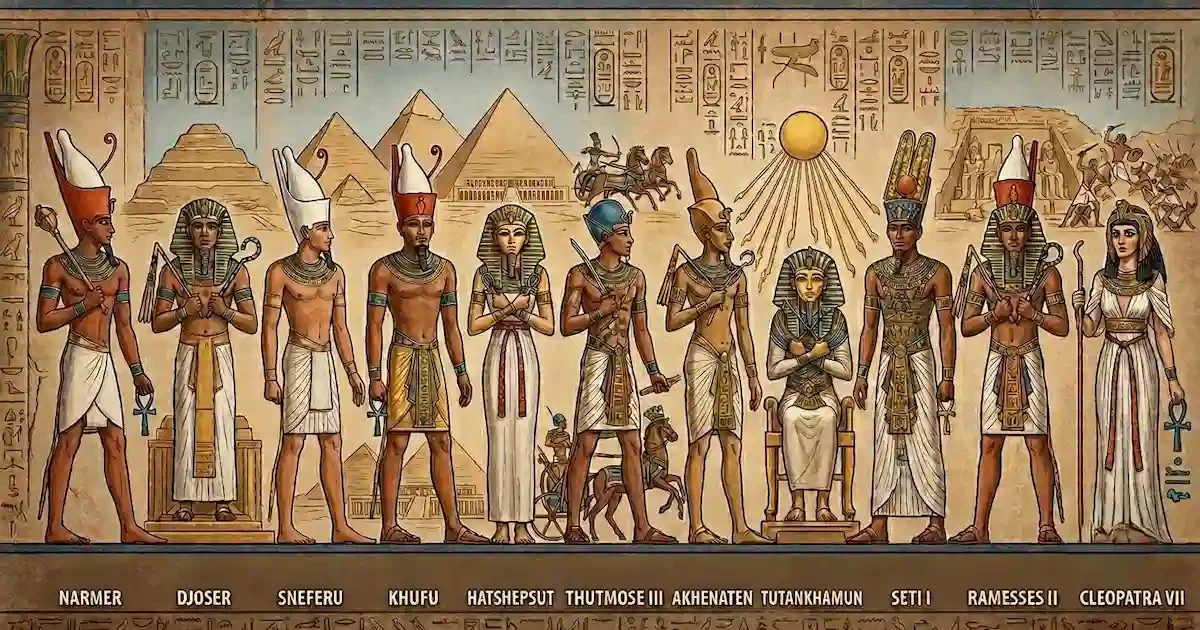
However, these eleven pharaohs stand among the most influential figures in Egyptian history.
Narmer (c. 3100 BCE)
Often identified with Menes, Narmer is credited with unifying Upper and Lower Egypt.
His famous Narmer Palette depicts this historic achievement and marks the beginning of dynastic Egypt.
For many historians, Narmer represents the starting point of the Egyptian state.
Djoser (c. 2670 BCE)
Djoser transformed Egyptian architecture forever.
Under the guidance of his architect Imhotep, he commissioned the Step Pyramid at Saqqara, considered the world's first large-scale stone monument.
Visitors exploring Saqqara today are witnessing the birthplace of pyramid construction.
Sneferu (c. 2613 BCE)
Sneferu was one of Egypt's greatest builders.
He experimented with pyramid design, creating the Bent Pyramid and Red Pyramid.
His innovations paved the way for the construction of the Great Pyramid.
Khufu (c. 2589 BCE)
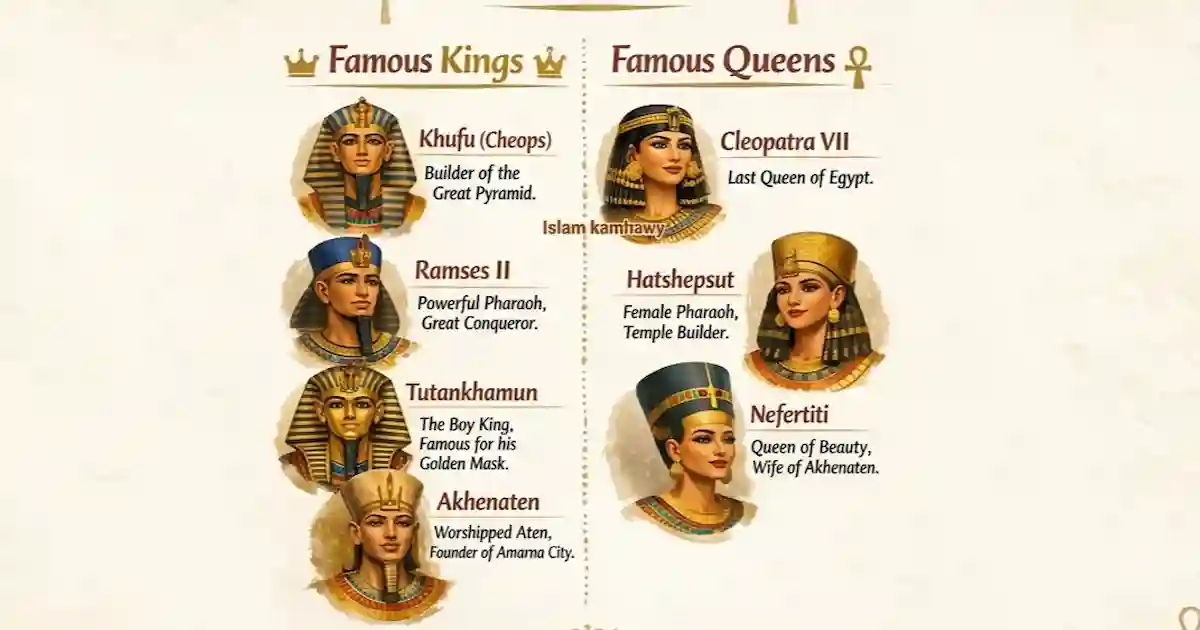
Khufu remains one of the most famous names in the list of pharaohs.
His greatest achievement is the Great Pyramid of Giza, the only surviving Wonder of the Ancient World.
Standing before this monument today remains one of the most unforgettable experiences for travelers visiting Egypt.
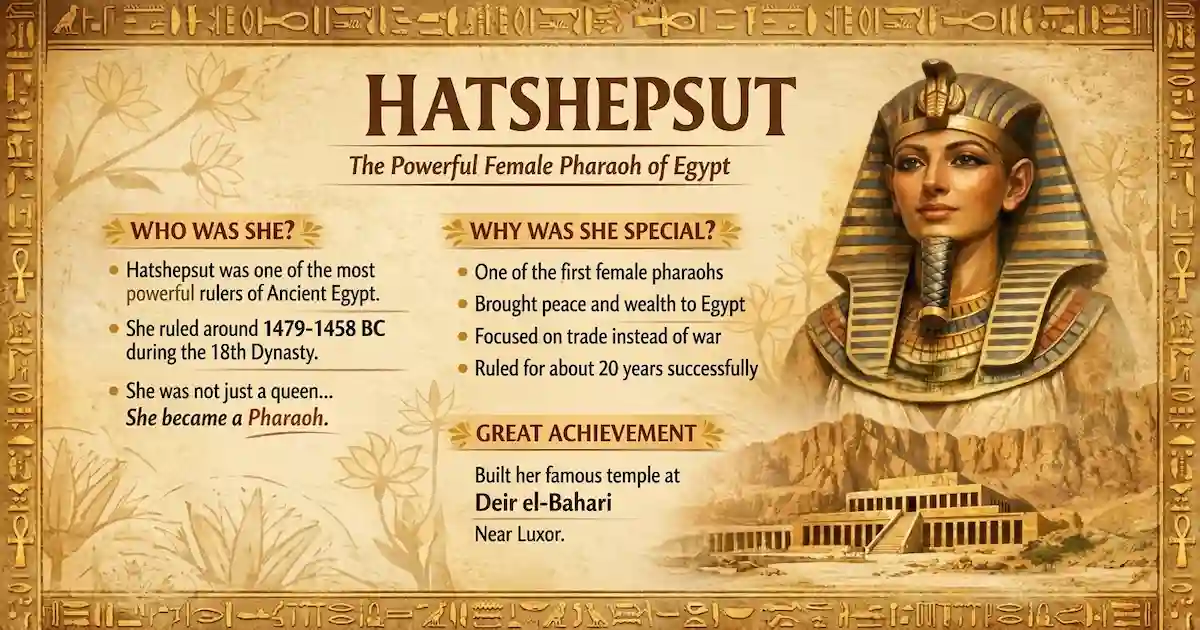
Hatshepsut (c. 1479 BCE)
One of history's most successful female rulers, Hatshepsut governed during a period of prosperity and peace.
Her magnificent mortuary temple at Deir el-Bahari remains among Egypt's architectural masterpieces.
Thutmose III (c. 1479–1425 BCE)
Often called the "Napoleon of Egypt," Thutmose III expanded Egypt's empire through successful military campaigns.
His victories helped establish Egypt as the dominant power in the ancient Near East.
Akhenaten (c. 1353 BCE)
Akhenaten introduced one of history's most remarkable religious revolutions.
He promoted the worship of Aten, the sun disk, challenging centuries of traditional Egyptian beliefs.
Those interested in Egypt's spiritual history may also enjoy exploring Ancient Egyptian Gods to understand the dramatic changes introduced during his reign.
Tutankhamun (c. 1332 BCE)
Although he ruled for only a short time, Tutankhamun became the world's most famous pharaoh.
The discovery of his nearly intact tomb in 1922 transformed modern understanding of ancient Egypt.
His golden mask remains one of the most recognizable artifacts ever found.
Seti I (c. 1290 BCE)
Seti I strengthened Egypt's military and restored many temples throughout the kingdom.
His beautifully decorated tomb in the Valley of the Kings is widely regarded as one of the finest examples of Egyptian funerary art.
Ramesses II (c. 1279 BCE)
Ramesses II, often known as Ramesses the Great, ruled for more than sixty years.
He constructed monumental temples, including Abu Simbel, and became one of the most celebrated Pharaohs of Ancient Egypt.
For many historians, Ramesses II represents the pinnacle of Egyptian royal power.
Cleopatra VII (c. 51 BCE)
Although often remembered for her relationships with Julius Caesar and Mark Antony, Cleopatra was a highly educated and capable ruler.
She became the last active ruler of ancient Egypt before the country became part of the Roman Empire.
Her story continues to captivate travelers and historians alike.
The Most Influential Pharaohs and Their Achievements
While all eleven rulers left important legacies, some transformed Egyptian civilization more dramatically than others.
Pyramid Builders
Djoser, Sneferu, and Khufu revolutionized architecture.
Without their innovations, the pyramids that attract millions of visitors today might never have existed.
Their building projects demonstrated extraordinary engineering skills and helped establish Egypt's reputation as one of the ancient world's greatest civilizations.
Military Leaders
Thutmose III and Ramesses II expanded Egypt's influence beyond its borders.
Their campaigns secured valuable trade routes, increased wealth, and strengthened Egypt's international position.
The prosperity generated by these rulers funded many of the temples and monuments that travelers admire today.
Religious Reformers
Akhenaten and Hatshepsut challenged traditional expectations in different ways.
Akhenaten attempted to reshape Egyptian religion, while Hatshepsut demonstrated that a woman could successfully rule one of the ancient world's most powerful kingdoms.
Their reigns reveal the remarkable diversity of leadership within Egypt's long royal history.
Together, these rulers illustrate why the Name of 11 Pharaohs remains central to understanding Ancient Egypt's extraordinary achievements.
Understanding the List of Pharaohs Timeline
One of the challenges for modern travelers and history enthusiasts is understanding where these rulers fit within Egypt's vast history.
The civilization of Ancient Egypt lasted for more than 3,000 years, making it one of the longest continuous cultures in human history.
A clear list of pharaohs timeline helps place each ruler within the broader story of Egypt's rise, golden ages, and eventual transformation.
Old Kingdom (c. 2686–2181 BCE)
Often called the "Age of the Pyramids," the Old Kingdom witnessed some of Egypt's greatest architectural achievements.
Important rulers from this period include:
Djoser
Sneferu
Khufu
This era saw the construction of the Step Pyramid, the Bent Pyramid, the Red Pyramid, and the Great Pyramid of Giza. These monuments established Egypt as one of the most advanced civilizations of the ancient world.
Middle Kingdom (c. 2055–1650 BCE)
The Middle Kingdom focused on political stability, economic growth, and cultural development.
Although none of our featured eleven pharaohs ruled during this period, it played a critical role in preserving Egyptian traditions and preparing the kingdom for future expansion.
New Kingdom (c. 1550–1070 BCE)
Many of Egypt's most famous rulers came from the New Kingdom.
This golden age included:
Hatshepsut
Thutmose III
Akhenaten
Tutankhamun
Seti I
Ramesses II
The New Kingdom saw massive temple construction, military expansion, international diplomacy, and remarkable artistic achievements.
Travelers visiting Luxor today are exploring the heart of this extraordinary era.
Late Period and Ptolemaic Era
The final chapter of ancient Egyptian rule culminated with Cleopatra VII.
Although her dynasty descended from Macedonian Greeks rather than native Egyptians, Cleopatra embraced Egyptian
traditions and became one of the most famous rulers in history.
Her reign marked the end of pharaonic Egypt and the beginning of Roman control.
Famous Pharaoh Names Travelers Should Know
When exploring Egypt, visitors often notice certain names appearing repeatedly on temples, statues, and museum exhibits.
Most Common Pharaoh Name
One of the most common pharaoh names was "Ramesses."
In fact, eleven kings used this royal name, including the legendary Ramesses II.
This explains why many travelers searching for the name given to 11 pharaohs of ancient Egypt encounter the answer "Ramesses."
The name became associated with power, legitimacy, and royal prestige.
Pharaoh Names Male
Most Egyptian rulers were male, and their names often reflected divine protection or royal authority.
Popular examples include:
Khufu
Thutmose
Amenhotep
Seti
Ramesses
Akhenaten
These pharaoh names male continue to appear in books, documentaries, museums, and archaeological research around the world.
Unique Royal Names
Not every ruler followed traditional naming conventions.
Akhenaten adopted a new name to reflect his religious reforms, while Cleopatra's Greek heritage made her name distinct from earlier Egyptian monarchs.
Travelers occasionally search for unusual queries such as a pharaoh name starting with U, but such names are extremely rare within Egyptian royal records.
The diversity of royal names reveals how Egypt evolved across different dynasties and cultural influences.
Why Pharaohs Remain Important Today
Thousands of years after their deaths, pharaohs continue to shape Egypt's identity and attract millions of visitors.
Their Impact on Egyptian Culture
The legacy of the pharaohs can be seen everywhere in modern Egypt.
Their monuments dominate the landscape. Their stories fill museums.
Their achievements continue to inspire architects, historians, and travelers alike.
The pyramids, temples, and tombs they commissioned remain among humanity's greatest cultural treasures.
According to UNESCO, Egypt's ancient monuments represent an irreplaceable part of world heritage and provide invaluable insight into human civilization.
What Modern Travelers Can Learn
Visiting Egypt offers more than historical knowledge.
It provides perspective.
Standing before the Great Pyramid or walking through the Valley of the Kings reminds visitors of humanity's enduring desire to create, remember, and leave a legacy.
The stories of these rulers reveal lessons about leadership, ambition, innovation, faith, and resilience.
For luxury travelers seeking meaningful experiences, few destinations offer a deeper connection to history than Egypt.
Where to See the Legacy of Egypt's Pharaohs
The best way to understand the Name of 11 Pharaohs is to experience their world firsthand.
Giza Pyramids
No visit to Egypt is complete without seeing the pyramids.
The Great Pyramid of Khufu remains one of the most extraordinary monuments ever built.
Watching sunrise over the Giza Plateau is a moment many travelers never forget.
Valley of the Kings
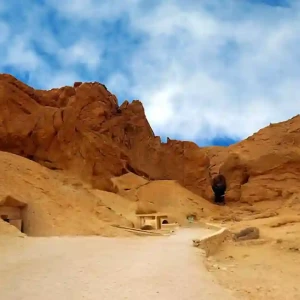
Located near Luxor, the Valley of the Kings contains the tombs of numerous New Kingdom rulers.
Among them are:
Tutankhamun
Seti I
Ramesses II's descendants
The colorful wall paintings inside these tombs remain astonishingly well preserved.
Abu Simbel
Built by Ramesses II, Abu Simbel stands as one of Egypt's most impressive temples.
The colossal statues guarding the entrance demonstrate the scale of royal ambition during Egypt's golden age.
Egyptian Museum and Grand Egyptian Museum
Museum collections provide an unparalleled opportunity to encounter royal artifacts up close.
Visitors can view statues, jewelry, sarcophagi, and treasures connected to many rulers featured in this guide.
Many premium Egypt Tour Packages combine these sites into carefully curated itineraries that bring Egypt's royal history vividly to life.
Name of 11 Pharaohs - FAQ
Who was the first pharaoh of Ancient Egypt?
Many historians identify Narmer as the first pharaoh because he united Upper and Lower Egypt around 3100 BCE, creating the foundations of the Egyptian state.
Who was the most famous pharaoh?
Tutankhamun is arguably the most famous due to the discovery of his nearly intact tomb.
However, Ramesses II and Cleopatra VII are also among the most recognized rulers worldwide.
What is the most common pharaoh name?
Ramesses is considered one of the most common royal names.
Eleven rulers used this name throughout Egyptian history.
Why were pharaohs considered gods?
Ancient Egyptians believed pharaohs served as intermediaries between humans and the gods.
They were viewed as divinely chosen rulers responsible for maintaining cosmic order.
Which pharaoh built the Great Pyramid?
The Great Pyramid of Giza was built for Pharaoh Khufu during the Fourth Dynasty and remains one of the most impressive achievements in human history.
Conclusion
The Name of 11 Pharaohs represents far more than a list of rulers.
These remarkable individuals shaped the political, religious, architectural, and cultural foundations of one of history's greatest civilizations.
From Narmer's unification of Egypt to Cleopatra's dramatic final chapter, each ruler contributed a unique piece to Egypt's extraordinary story.
Their monuments continue to stand as symbols of ambition, innovation, and enduring legacy.
For travelers, understanding these famous rulers transforms every visit to a temple, pyramid, or museum into a richer experience.
Explore our Egypt Tour Packages and discover the world of the pharaohs where history still feels vividly alive.